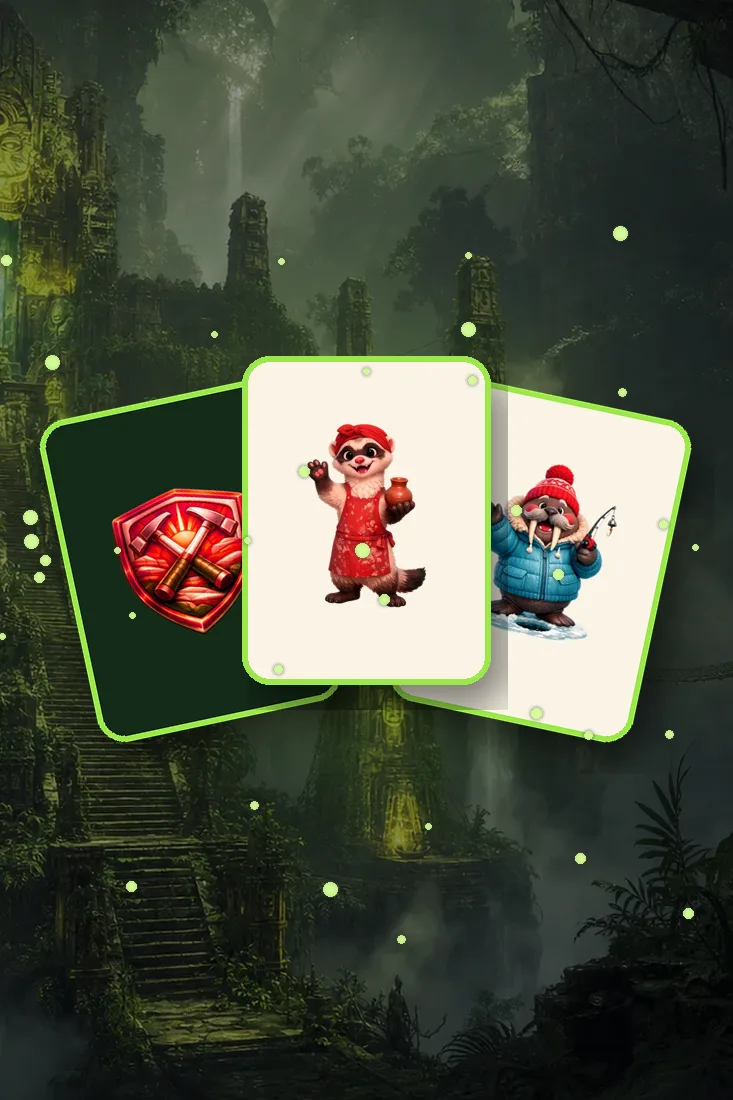
Fernfall Dash sets Dottie running along the lagoon shore, all by herself, while the misty waterfall painting drifts past slowly in the background and nearer fronds rush by much faster. There is exactly one thing for you to decide: when to hop. The first few seconds are relaxed, almost a stroll, but the shore has a habit of filling up just as you settle in.
Ember geodes and flat fossil stones sit on the ground, sunrise gliders sweep across at head height, and pieces of amber float along in gentle arcs. Every metre adds a point, and every piece of amber you collect adds a bonus. Clip anything and time stretches for a moment, a burst of leaves flies up, and the run is over with your distance and points on show.
How to play Fernfall Dash
- Press Play and Dottie starts running along the shore straight away at an easy pace.
- Tap, click, press Space or the Up arrow to hop over a geode or fossil stone ahead.
- Hold the button longer for a higher, floatier leap, and tap once more in mid-air for an extra hop.
- Shape your hops so they pass through drifting amber for bonus points on top of your distance.
- Keep clear of every obstacle as the speed slowly rises; one bump ends the run and saves your best.
Fernfall Dash controls
Getting better at Fernfall Dash
- Short taps clear ground obstacles neatly; a full held leap can drop you right onto the next one.
- Keep the mid-air hop in your pocket for the moment a glider appears just after take-off.
- Gliders are often easier to stay beneath than to clear, so sometimes the best hop is no hop.
- Only chase amber when the ground ahead is empty; bonus points are never worth an early finish.
- As the shore speeds up, hop a fraction earlier than feels right, because each leap covers more ground.
Every gap on the shore can be cleared
One rule held firm while we built Fernfall Dash: every obstacle must be hoppable. Spacing is checked as the shore is laid out ahead of you, so if you clip a geode, the timing was off rather than the gap. That honesty is what makes the next run tempting. You know exactly what went wrong, and you usually know how to fix it straight away.
The speed creeps up smoothly instead of lurching. The opening stretch is slow enough to learn how a held leap feels, and by the time the shore is flying past, your thumb has found the rhythm. That gentle curve means a first-time player and a regular can both enjoy the same opening seconds, and the regular still has plenty of road left to conquer.
Metres or amber: picking the shape of a run
A score grows two ways. Distance pays a steady point per metre and simply rewards staying upright. Amber pays in bursts, but it drifts in arcs, so collecting it can mean a taller leap than the ground needs. Early in a run, nearly every piece is easy to grab and worth the detour.
Later, with the shore busy and the pace brisk, a sensible runner lets awkward amber float by and banks metres instead. Spotting the moment to switch from greedy to careful is where personal bests come from. Watching the distance tick past your old record while Dottie sails over one more geode is about as happy as Ferndale gets on a grey British lunchtime.
Questions about Fernfall Dash
Your normal hop plus one extra while airborne. Once both are used, Dottie needs to land before she can hop again.
Yes, gradually. The pace builds smoothly over a run, so after a minute or two of clean hopping things feel noticeably quicker.
Each metre adds one point and each piece of amber adds a bonus. Distance, points and your best are shown while you play, and a new best is saved the moment the run ends.