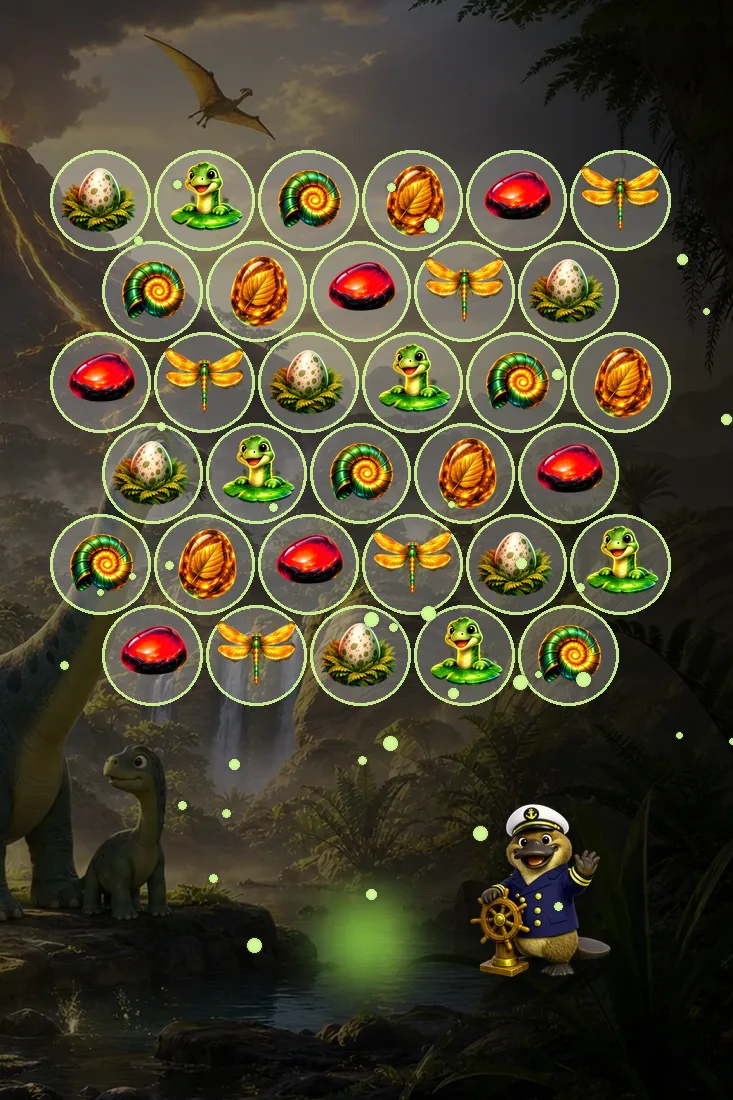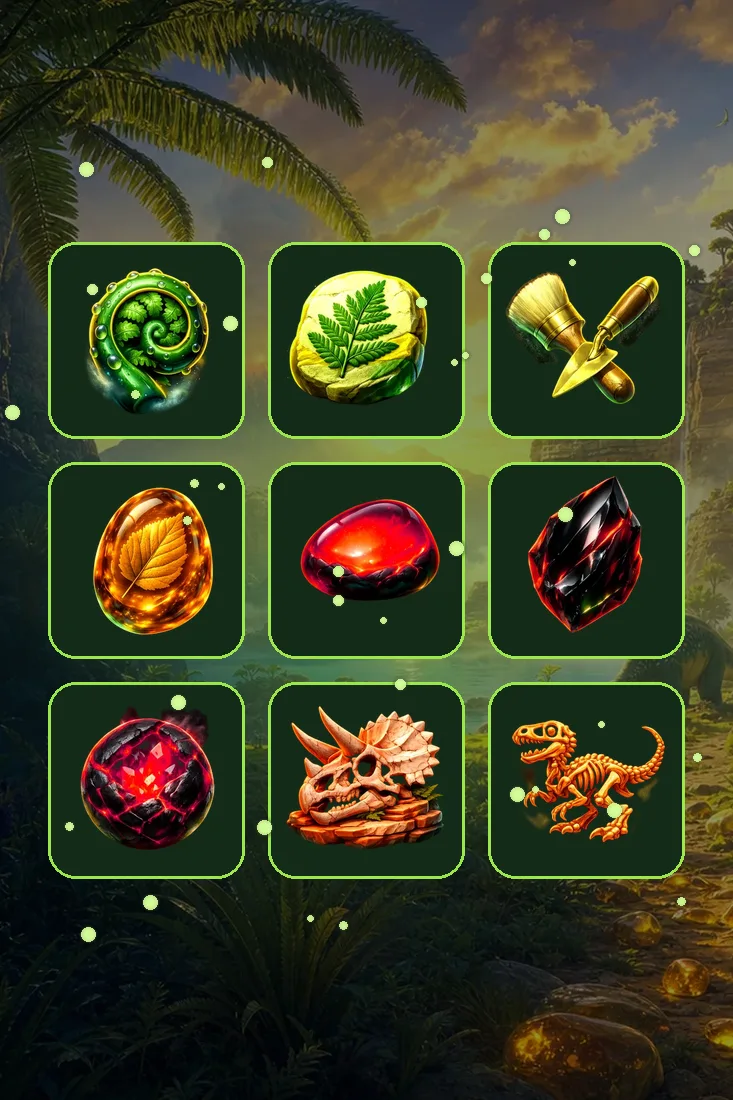
Fossil Stack is set on a sorting tray at the Bonecliff dig, where finds arrive muddy and unlabelled. Each tile shows one of thirteen finds arranged in order of rarity: a fiddlehead frond, a fern fossil, a brush and trowel, a glowing ammonite, a leaf in amber, then lava pebble, obsidian shard, ember geode and thunder egg, followed by a glowing claw, a horned skull, the hammer crest of the dig team and, at the very top, a golden skeleton.
Push the tray and every find slides as far as it can go. When two identical finds meet they fuse into the next one up the list, with a pop and a little sparkle, and you earn points that grow larger the rarer the result. After every push a fresh find lands in an empty square, usually a fiddlehead and occasionally a fern fossil. The game ends only when no push can change anything at all.
How to play Fossil Stack
- Press Play on the start screen, or switch to the wide 5x5 board first if you want extra elbow room.
- Swipe across the tray, or use the arrow keys or WASD, to push every find in that direction.
- Let two identical finds collide to fuse them into the next, rarer find and collect points.
- Watch the strip of thirteen finds under the tray, which lights each one the first time you reach it.
- Keep pushing until the tray locks solid, then have another go and try to beat your best.
Fossil Stack controls
Getting better at Fossil Stack
- Choose a home corner for your rarest find and build a descending chain along one edge from there.
- Lean on two directions for most pushes and use the third only when the tray truly needs it.
- Avoid pushing away from your home corner; it lets a fresh fiddlehead slip in behind your best piece.
- Hold your Undo until a push genuinely wrecks your chain, not merely when a row looks a bit untidy.
- Try the 5x5 board to see the upper finds for the first time, then bring that habit back to 4x4.
Thirteen finds that tell a little dig story
We wanted every fusion to feel like progress on a real excavation. A fern fossil meeting another fern fossil and becoming the tools to dig with is a tiny joke; amber becoming a lava pebble moves the story from the lagoon to the volcano. By the time you are fusing thunder eggs you have travelled the whole valley in miniature, and the golden skeleton feels like the find of the season.
The strip beneath the tray makes the journey visible. Every find you have not yet reached sits there dimmed, and it brightens the moment you first make one. Even a short game over breakfast can light a new square, which is a cheerful reason to play, and a dark horned skull at the end of the strip is a cheerful reason to come back.
Spending a single Undo like a professional
One Undo per game is a deliberate choice. During testing, unlimited undoes turned the tray into a shrug, because you could simply try every direction. With none, one slip of a thumb could undo twenty minutes of careful work. A single rescue keeps the tension and still forgives the worst accident.
The best time to use it is when a push breaks the shape of your tray rather than its tidiness. Dragging your rarest find out of its corner, or letting a fiddlehead wedge itself between two thunder eggs, is worth an Undo. A slightly ragged row is not, because the next couple of pushes often sort it out by themselves. Take a breath before pressing it; half the time a calmer look reveals a way out.
Questions about Fossil Stack
A message celebrates the find, the last square of the strip lights up, and you can carry on with the same tray to push your score even higher.
It is more forgiving. The extra squares give you more space before the tray fills, so games run longer and the rarer finds are easier to reach while you learn.
Every fusion scores, and each step up the list is worth twice the one below it. The big totals come from late fusions near the top, so patience pays.