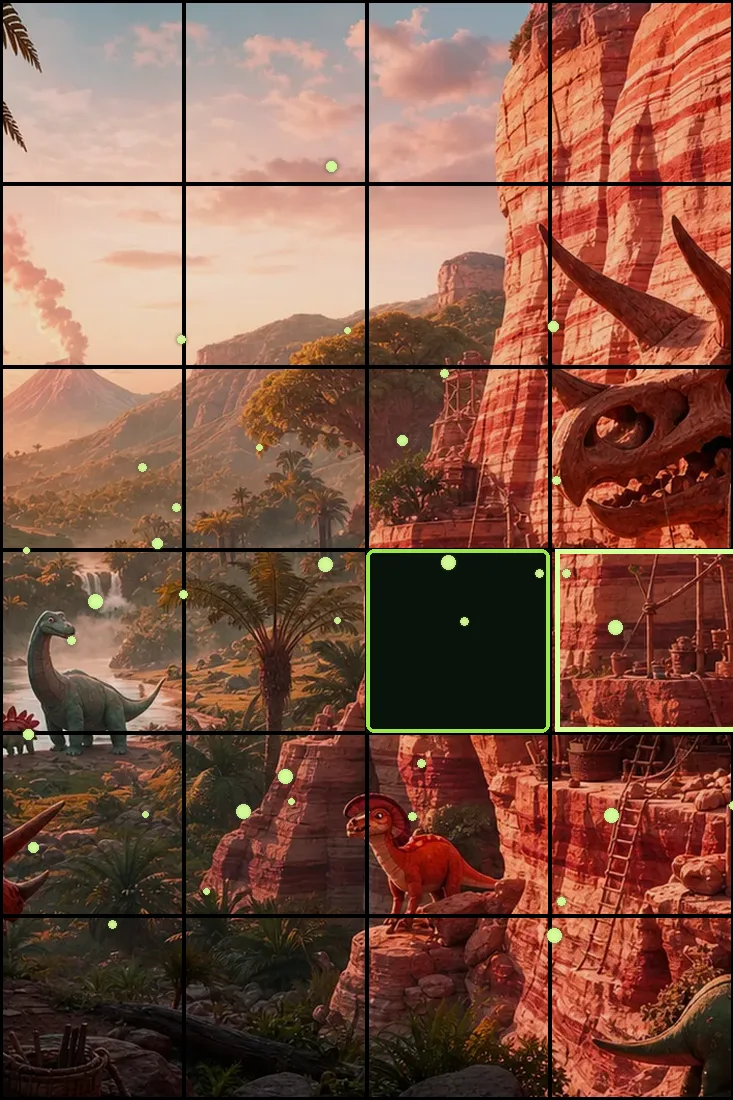
Strata Shuffle takes the eight scenes painted for our valley and cuts each one into a grid of square tiles with a single gap. There is the sunrise over the whole valley, the waterfall lagoon, the half-dug skeleton at Bonecliff, the volcano at dawn, the canopy temple, the overgrown chambers, the crystal mine and the cloud isles. Pick a picture, pick 3x3, 4x4 or 5x5, and the tiles fly out of place.
To play, slide any tile in line with the gap into it, by tapping, swiping or using the arrow keys. A move counter and a timer run along the top. Stuck on which bit of sky goes where? Hold Peek to see the finished painting, or switch on Numbers to show each tile’s position. When the last tile clicks home, the full picture appears and your stars are counted.
How to play Strata Shuffle
- Press Play, then choose one of the eight valley pictures and a size of 3x3, 4x4 or 5x5.
- Tap a tile in line with the gap, swipe, or use the arrow keys to slide tiles into the space.
- Hold Peek, or press P, whenever you want to see the finished picture for a moment.
- Switch on Numbers, or press N, if you would rather work from tile positions than from the painting.
- Finish the picture in as few moves as you can; a lower count earns more stars.
Strata Shuffle controls
Getting better at Strata Shuffle
- Solve the top row first, then the left column, and you are left with a smaller puzzle each time.
- Place the last two tiles of a row together; bring them in side by side and slip them home as a pair.
- Tapping a tile two or three away from the gap moves the whole line at once, which saves effort.
- Use Numbers on the 5x5 the first time; skies and seas can look alarmingly similar tile to tile.
- Replay a picture you know at a bigger size, as the painting itself becomes a helpful map.
Shuffles that can always be solved
Half of all random arrangements of a sliding puzzle cannot be solved at all, which is a cruel trick to play on anyone. Strata Shuffle never starts from one of those. Every board is scrambled by making real moves from the finished picture, so a solution always exists, and each shuffle is checked to make sure it is properly mixed.
That means you can play without that nagging worry at the back of your mind. If a corner refuses to come right, it is a puzzle to think through rather than a dead end. The tiles always tumble out from the finished painting at the start, too, which gives you one last look at the scene before the work begins.
Three sizes, eight paintings, and a star for every finish
With eight pictures and three sizes there are twenty-four boards to finish. A 3x3 is a pleasant warm-up you can solve on a bus. A 4x4 asks for a method. A 5x5 is a proper project, the kind you start with a fresh pot of tea on a drizzly Sunday and finish feeling rather pleased with yourself.
Stars reward thrift. Before you begin, the board shows the move counts for three stars and two stars on that shuffle, and every completed picture earns at least one. Your best result for each picture and size is remembered on your device, so going back to tidy up a sloppy finish is a challenge all of its own.
Questions about Strata Shuffle
Yes. Every shuffle is made by moving tiles from the finished picture, so a route back always exists.
Holding Peek shows the finished painting over the board for as long as you hold it. Numbers marks every tile with its home position, which helps a lot on the larger grids.
By moves. Each shuffle has a target for three stars and a looser one for two, shown before you start. Finishing at all always earns one star.