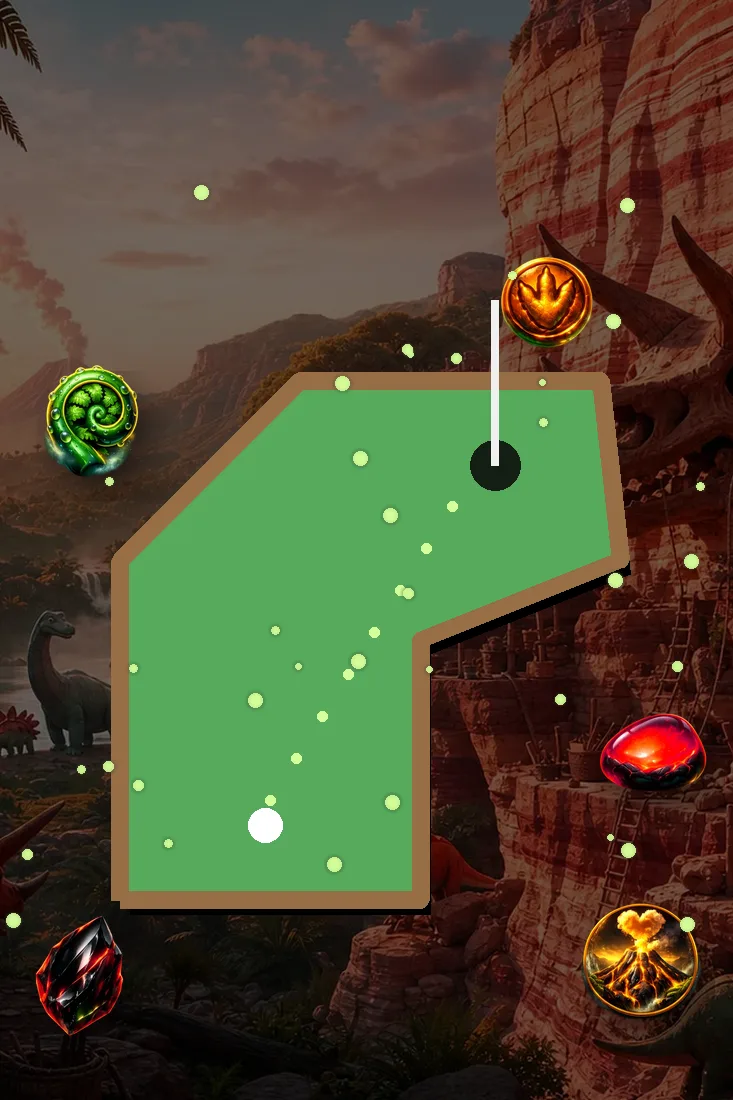
Mini golf rewards the player who looks before they putt. These are the habits that turn a scrappy card into one you will want to beat.
Look at the whole hole before you touch the ball
In a top-down mini golf game you can see everything at once, which is a luxury no real course offers. Use it. Before the first putt on any hole, take a few seconds to trace a path from the ball to the cup with your eyes, noting every wall, bumper, slope and hazard along the way.
Very often there are two or three possible routes. One is direct and risky, another is longer but forgiving. Decide which one you are taking before you start aiming. Most poor scores come from changing your mind halfway through the pull-back, or from simply firing at the cup and hoping.
Par helps here. A par two invites a confident approach and a tidy tap-in. A par four tells you the designer expects a detour, so there is no shame in playing it in stages. Taking par as a hint rather than a target makes the whole round calmer, and it stops one awkward hole from souring the rest of the card.
Judging power with a pull-back
When you aim by dragging back from the ball, the length of your pull sets the strength of the shot. The guide line shows direction, but the distance the ball will roll is down to you. The single most useful habit is to start softer than you think you need.
A ball that stops a short way from the cup is easy to finish. A ball that races past rebounds off the back wall and can end up further away than where it started. In most courses, gentle and slightly short beats hard and long, especially on holes with slopes or bumpers waiting behind the cup.
Try to build a feel for a few standard pulls: a short tap, a medium roll and a long drive. Using roughly the same three lengths over and over teaches your hand quickly. After a round or two, you will find yourself picking the right one without thinking. When a putt comes up short or long, note which way and adjust the next pull only slightly, rather than swinging wildly the other way.
Using walls like a cushion
Walls are not obstacles so much as tools. A ball bouncing off a straight wall leaves at the same angle it arrived, just like light off a mirror. Once you picture that, bank shots stop feeling like luck and start feeling like geometry you can do in your head.
A trick that helps is to imagine a mirror image of the cup on the far side of the wall. Aim at that imaginary cup, and the bounce will send the ball towards the real one. It works astonishingly well for single banks and is a fine starting guess even for doubles.
Remember that each bounce takes a little speed off the ball. A shot that needs two walls needs a touch more pull than a straight putt over the same distance. Bumpers are different again, because they kick the ball away more sharply, so give them extra room unless you mean to use them. Used on purpose, though, a bumper can fire the ball round a corner faster than any wall.
Slopes, sand, water and gates
Slopes bend the path of a rolling ball, pulling it gently towards the low side. Aim a little uphill of your true target and let the slope bring the ball round. Slow putts curve more than quick ones, because the slope has longer to act on them. On a steep bank it can even be worth putting slightly away from the cup and letting gravity do the rest of the work for you.
Sand is the great speed thief. A ball entering a patch of sand slows dramatically, so either avoid it with a cleaner line or add plenty of pull when your route must cross it. Water simply sends the ball back to try again, which costs a stroke rather than the round, so treat it as a strong reason to play safe.
Moving gates reward patience. Watch a full cycle of the gate opening and closing before you putt, and count how long your ball will take to reach it. It is far better to wait a few seconds and arrive as the gate swings open than to fire immediately and bounce off it. A gentle, well-timed putt through an open gate is one of the most satisfying shots on any course.
Keeping a calm scorecard
Mini golf is a game of small margins. One rash putt on a tricky hole can cost two or three strokes, and that is the difference between a good card and an ordinary one. When a hole goes wrong, the most important shot is the next one, and it deserves your full attention.
It also helps to know your nemesis holes. Every course has one or two that catch you out. Play them slowly, aim for a safe par, and save your bold shots for the holes you know well. Over a round, that steadiness adds up to a far better total than heroics. Save the daring bank shots for the holes where a miss still leaves an easy second putt.
Finally, enjoy the replay. With a course of nine holes, each round teaches you something you can use next time: a better line on the bend, a softer touch by the pool, a cleaner bank off the long wall. Watching your total creep down over a week of evening rounds is one of the gentlest pleasures in any game.